This is what kids should be learning。这才是孩子们该学的。二〇一七年七月,他把这份赞赏说得很直接。
舞者的手又换了一个姿势。该伸的伸开,该弯的弯着;一句话还没有出口,身体已经做了许多功课。
功课也在指尖。
This Transmission
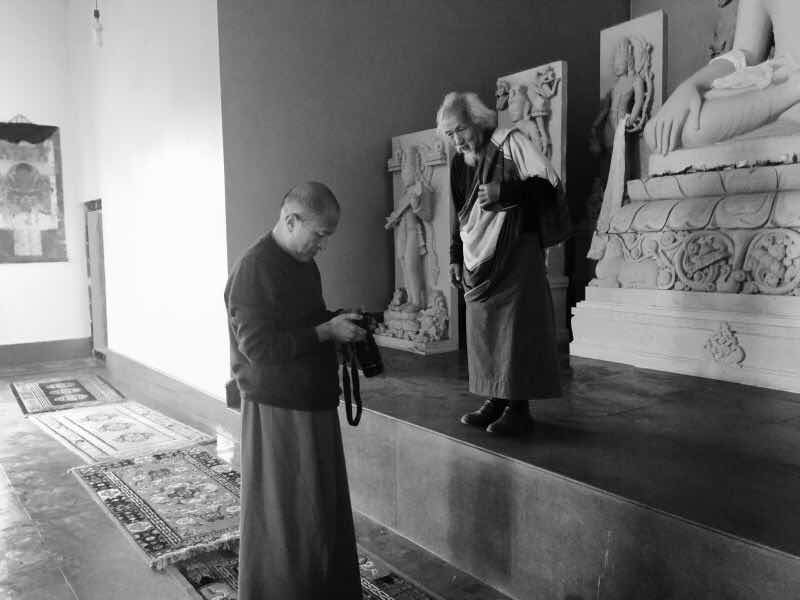
Aperture and shutter speed can be a transmission too. When Rinpoche speaks of learning them, he chooses that solemn word. The small distinctions of a camera suddenly have the standing of a lineage.
“Getting transmission of f stop and shutter speed”. In April 2015, he gives the lesson this ceremonious description.
Before the statues, two robed figures stand at different levels. One looks down at the camera in his hands, its strap hanging below. For all the size of the statues nearby, the small matter at hand remains in his hands.
Someone who speaks of transmissions has made room for aperture as well. There is still something to learn when it comes to the shutter.
How Others Learn
Some lessons need a roomful of people. Tables and chairs gather by the windows, faces rising above dark red robes. Someone stands to speak; those seated turn towards the speaker.
In May 2015, Rinpoche’s concern is “Learning to make others learn”. Teaching, it turns out, has not put anyone beyond learning.
A white sheet is fixed to a board. One person holds a microphone; another points to the paper. Those listening need to see, and those presenting need to make themselves understood. “How to learn”, he asks.
Making it clear.
Another of his remarks gives the room its social shape: learning is something done together. Pointing, asking, letting someone else speak—the lesson extends beyond the sheet of paper.
A speaker stands beside a screen with a sheet of notes, looking down, then ahead. Rinpoche’s encouragement for this moment is “Big leaps”. Standing up to deliver a page of words can earn a phrase that large.
Learning to Laugh
A teacher’s face belongs in the lesson too. A speaker holds a microphone in one hand and a small coloured object in the other. Rinpoche mentions teachers’ expressions, then adds “Mask”. The face normally presented to a class has become something to consider in its own right.
When the laughter comes, the room loosens. One person tilts his head back, another bends forward, eyes narrowing behind spectacles. The water bottles on the tables remain perfectly upright.
Rinpoche includes this in the curriculum: “Learning to lough”. Laughter has a lesson of its own.
Earlier, people gathered around tables to listen. Now smiles pass from face to face. The serious work has lost nothing in the process.
A lesson everyone can share.
For the Children
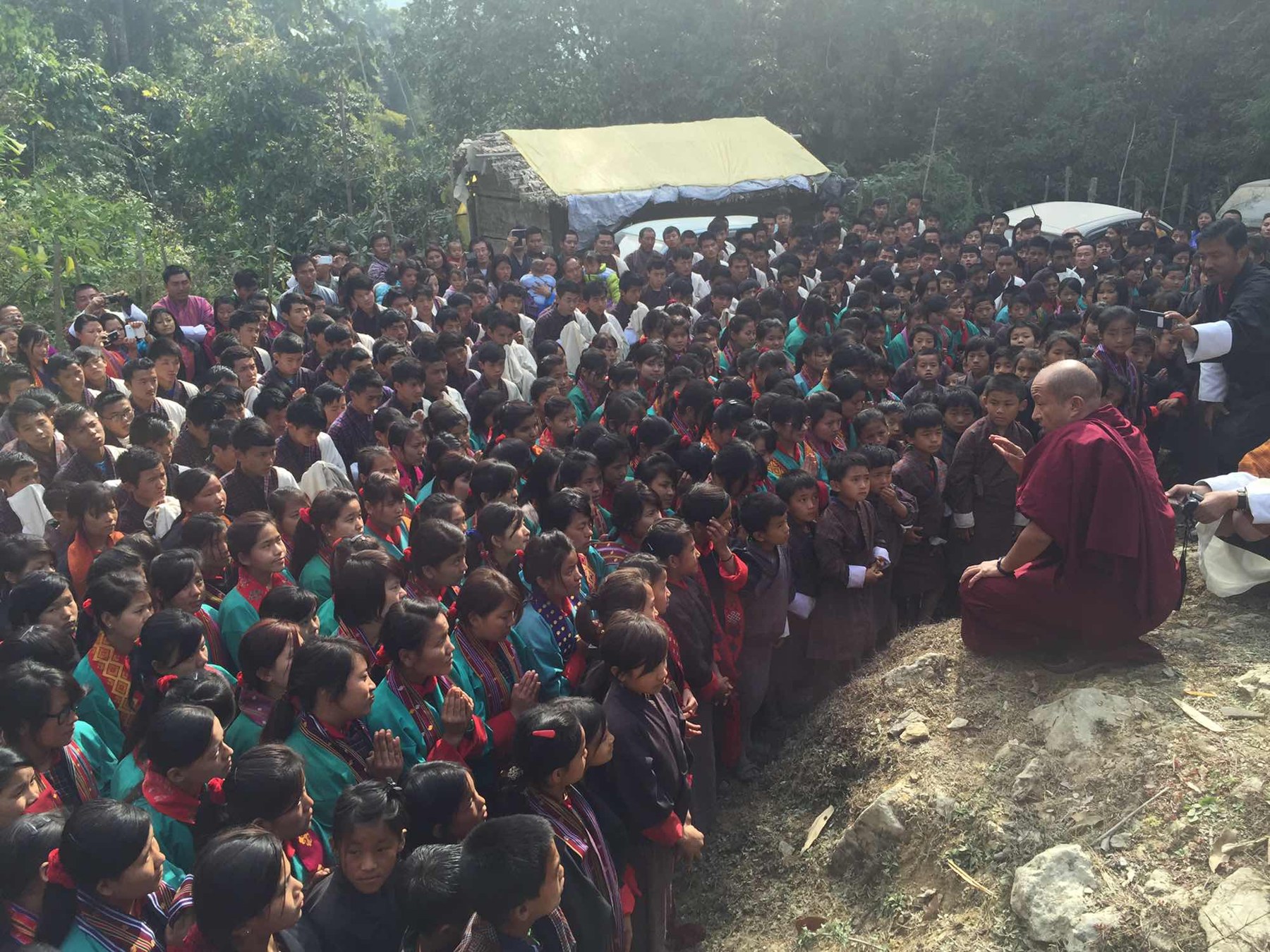
With a crowd of children before him, he says he is teaching them “Wilde and naughty things”. The name comes first, the naughtiness after it. This teacher has shifted the solemn furniture a little.
The children sit close, row after row, their clothes spreading colour beneath the trees. The speaker is near; beyond him are more faces, and only above the heads can the canopy at the back be seen.
A gathering beneath the trees.
He has also invited attention to learning through joy. In 2016, he introduces a children’s and young people’s programme in Bodh Gaya under the word “Learning”. Its invitation proposes setting aside textbooks, teachers and classrooms.
The space for a lesson grows wider. A child need not only sit at a desk; learning may begin with a little joy.
The Hands Know
Watching a dancer, he thinks of children again. Beneath a golden headdress, the dancer extends an arm, turns a wrist, and shifts her gaze with the pose. Even the small space at the fingertips has its discipline.
“This is what kids should be learning”. In July 2017, he states his appreciation directly.
The dancer’s hands change position again. Some fingers extend, others curve. Before a word has been spoken, the body has already done a great deal of learning.