A green-covered album opens. Setsuko Hara is smiling inside. A page turns: her face is in profile. Another turns: her hair falls loose, and the smile is different. The photographs sit in clear sleeves. Light from the room travels over them as the pages move.
Rinpoche has one word for her: “Formidable”.
A wonderful word to give someone.
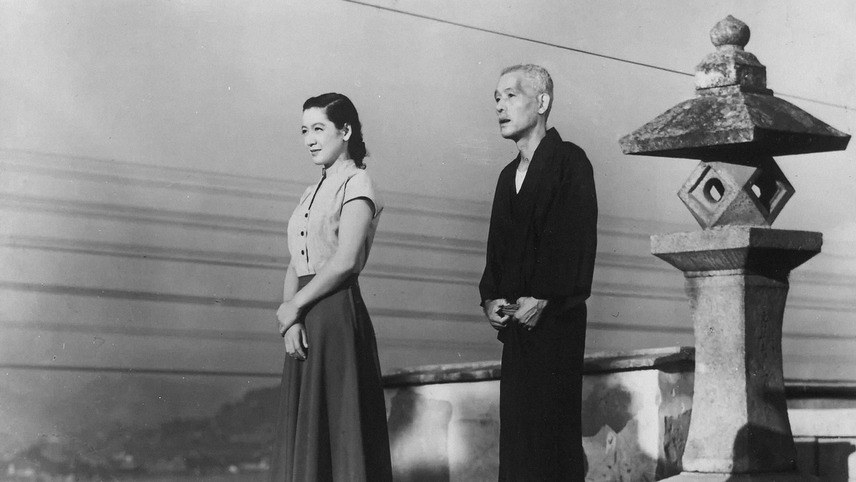
He is generous with praise for the people he loves to watch. When he sees Tokyo Story again, several words of admiration are still not enough. He singles out Hara: “Miss Hara is just too much.” The film is wonderful; the lady deserves a sentence of her own.
He has seen it before. His delight, though, is fresh. A familiar film can still give him cause to marvel at Hara all over again.
Such affections can occasion a little upheaval. He bids goodbye to Ray, welcomes Ozu back, and admits his mistake: he had forgotten that Ozu was, and still remained, the greatest. An old love has the upper hand again. There must be a proper welcome.
Things to Do in a Forest
Making a film himself was a busier business.
In the forest where Hema Hema is being made, several people come along a narrow path. The ones in front wear yellow. A great red object rests on their shoulders. Branches and leaves reach in from both sides, and the object rises and falls with their steps. Underneath it, they have to watch the path while minding their burden. It is not an easy walk.
Rinpoche calls this bustle “chaos”.
A path through the forest.
There are people resting in the forest, too. Beside the path, someone sits crouched in the earth, a cup near his feet, plants growing close around him. “exhaustion”, says Rinpoche. Things must be carried, paths walked. The light and shadows of a film take bodily effort to make.
Yet when he gives thanks, he includes the forest. Leaves, branches, trees, even insects. It is November 2015, and the shooting is only halfway done. These small residents of eastern Bhutan have already received his gratitude alongside the crew.
More than ninety percent of the crew are Bhutanese, and most are amateurs. He praises their dedication and their sincere love of art. Money raised has helped the filming begin; editing, sound mixing and color correction still lie ahead. Outside the forest, many others are helping.
There was something he wanted to say plainly first. He felt uneasy asking for help with this undertaking. It was nothing holy or spiritual. He could not promise that it would benefit sentient beings or the dharma.
They were doing it for the love of art.
After so much trouble for the sake of art, his account of why he is doing it is brief. In giving thanks, though, he remembers even the insects in the forest.
Light on a face.
Not Too Bad
By the time the final color correction is done, it is February 2016. The film can at last leave his hands. Rinpoche writes to thank those who have given money and work. Festivals still lie ahead; this chapter is complete.
When it came to praising his own work, he grew economical. No artist was ever entirely satisfied. Still, the film was finished.
“it’s not too bad.”
Not too bad.
Hara is formidable. Ozu is the greatest. His own film, made through chaos and exhaustion, receives this much. For the cast, crew and supporters, his thanks are much longer. Of their harmony and the generosity that has come from far and wide, he has plenty to say.
Ozu need not worry about a shortage of warm words. “sublime”, followed by “Yes.” As though, having given the praise, Rinpoche supplies a small nod of his own.
A little more slowly.
In the green-covered album there is Hara with a bicycle, her hands on the handlebars, a closely woven basket in front. She is smiling. Her expression has changed from page to page; this one is another reason to linger.